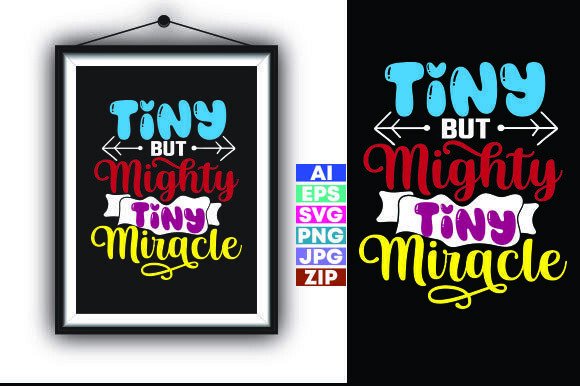
Tiny but Mighty: A Designer's Review for Real Embroidery
When I first pulled up the Tiny but Mighty. Tiny Miracle design on my screen, I didn't just see a graphic; I saw a potential bestseller for the upcoming baby shower season. As someone who spends hours hooping fabric and threading needles, my first instinct is always to look past the pretty preview and ask: "How will this actually stitch out?" This isn't just about having a cute image; it's about creating a finished product that holds up to washing, wearing, and the critical eyes of paying customers.
The mood of this piece is immediately warm and protective. The typography suggests something delicate yet resilient, which fits perfectly with the theme of new life or overcoming small obstacles. Visually, it feels like a natural fit for baby embroidery, nursery decor, or even a subtle statement on a parent's custom apparel. However, before committing to a full production run for my shop, I need to break down exactly how this machine embroidery design behaves under the needle.
First Impressions and Visual Personality
The layout of Tiny but Mighty. Tiny Miracle strikes a balance between modern simplicity and classic sentimentality. For an Etsy seller or craft business owner, visual personality is everything. You want a design that stops the scroll. This graphic has a clean structure that suggests it would translate well into a satin stitch for the lettering, providing that smooth, glossy finish customers love on high-end items. The spacing appears generous enough to avoid thread bunching, a common pitfall in text-heavy graphics.
What stands out most is its versatility. While the product category lists it under T-Shirt Designs, my experience tells me this shines brightest on textured fabrics. Imagine this stitched onto a waffle-knit baby blanket or a structured canvas tote bag design. The contrast between the crisp lines of the text and the organic texture of the fabric creates a tactile appeal that flat printing simply cannot match. It feels like a personalized gift that carries weight and meaning, rather than just another mass-produced item.
Real-World Application: The Sweatshirt Test
To truly evaluate this embroidery file, I mentally projected it onto a few real-life scenarios. The most compelling use case I envisioned was a matching set for a mom and her newborn. Picture a heather grey sweatshirt embroidery project where Tiny but Mighty. Tiny Miracle sits proudly on the left chest. In this context, the design acts as a badge of honor for the parent.
For a small shop product, consistency is key. If I were selling this as part of a boutique collection, I would pair it with simple floral elements or a minimal border to create a cohesive brand look. The design's strength lies in its clarity. Even from a distance, the message is readable. This is crucial for commercial embroidery projects where the item might be viewed on a shelf or in a photo thumbnail. A muddy or overly complex design gets lost; this one commands attention without shouting.
I also considered its use on non-apparel items. A kitchen towel or a pillow cover in a neutral linen would allow the stitching to pop. For holiday embroidery, perhaps as a stocking label or a tree skirt accent, the sentiment fits beautifully. The key here is understanding that the design is the star, so the background material should support it, not compete with it.
Technical Considerations for the Stitcher
Now, let's get into the nitty-gritty that separates hobbyists from professionals. When working with text-based designs like Tiny but Mighty. Tiny Miracle, stitch density is the make-or-break factor. If the density is too high on a stretchy fabric like a jersey t-shirt, the garment will pucker, ruining the handmade product's drape. Conversely, if it's too low, the fabric might show through, making the letters look sparse and unprofessional.
Before running this on a client's expensive garment, I always advise testing on scrap fabric first. You need to check how the thread colors interact with the material. Dark fabrics require a different approach than light ones; sometimes a white underlay is necessary to prevent the base color from dulling the vibrancy of the top threads. Since the provided details mention formats like JPG, AI, SVG, and EPS, it is vital to confirm if you are receiving a native embroidery file (like PES or DST) or if you need to digitize these vector graphics yourself. If you are using this as a print-and-cut or appliqué reference, the editable AI file and SVG File are gold mines for creating custom embroidered patch backings or heat transfer vinyl layers.
Special attention must be paid to hoop size constraints. If you are planning to stitch this on a cap or a curved surface, ensure the design fits within your smallest hoop without losing detail. Small lettering can easily become a tangled mess if the machine struggles with tight turns. Additionally, for items that will see frequent washing, like baby clothes or aprons, using a high-quality stabilizer is non-negotiable. It ensures the running stitch or fill areas remain intact after dozens of cycles.
Maximizing Value and Customer Trust
In the world of digital embroidery file sales and handmade goods, trust is your currency. When a customer buys a shirt featuring Tiny but Mighty. Tiny Miracle, they aren't just buying cotton and thread; they are buying the assurance of quality. A clean, well-executed stitch job signals professionalism. It tells the buyer that you care about the details. This directly impacts your brand consistency and buyer engagement.
For those creating printable mockups or digital previews, this design offers excellent potential. Its clear lines render beautifully in photos, helping to drive sales on platforms like Etsy. However, remember that a mockup is a promise. The physical finished product must deliver on that promise. Inspect small details closely. Are the corners of the letters sharp? Is the spacing even? These micro-decisions define whether your item looks like a boutique product or a DIY experiment.
Final Verdict and Designer Notes
Tiny but Mighty. Tiny Miracle is a strong contender for any designer's library, provided it is handled with technical care. It bridges the gap between sentimental value and modern aesthetic, making it suitable for a wide range of embroidery projects. Whether you are decorating a tea towel for a housewarming gift or building a line of custom apparel for a local boutique, this design has the legs to carry your vision.
My final advice is to treat the file formats with respect. Since you receive High Quality JPG, Editable AI, SVG, and EPS files, verify your workflow. If you are sending this out for digitizing or converting it into a stitch file yourself, ensure the resolution of the JPG is sufficient for tracing, or better yet, rely on the vector data in the AI and EPS files for crisp edges. Always check licensing terms before selling finished items or digital products derived from these assets. With the right fabric, proper stabilization, and a keen eye for detail, this design can become a staple in your craft business, delivering joy to recipients and revenue to your bottom line.